

Guides

20 Aug 2026

Brick is one of the most durable and enduring building materials available. However, even the best brickwork can be permanently disfigured by inappropriate cleaning.
In our experience, more damage is done to brickwork through incorrect cleaning than in almost any other part of the bricklaying process. Excessive pressure, unsuitable chemicals, overly strong acid solutions, incorrect timing and poor technique can damage brick faces, erode mortar joints, alter colours and create stains that were not present before cleaning began.
The most important principle is simple:
A cleaning process must be selected for the particular brick, mortar, contaminant and site conditions. What works successfully on one wall may seriously damage another.
Important: This article is a general guide only. It is intended to help readers understand the principles and risks associated with brick cleaning; it is not a set of detailed cleaning instructions. Always consult the brick supplier, cleaning-product manufacturer and a suitably experienced professional before cleaning brickwork. Chemical products must only be used in accordance with their current label, Safety Data Sheet and applicable regulations.
The safest and most effective form of brick cleaning is prevention.
The cleaner the bricklayer leaves the wall, the less aggressive the eventual cleaning process needs to be. Mortar extruded from joints should be removed cleanly during laying, before it becomes firmly attached to the brick face. Once the mortar has lost its tackiness but remains workable, remaining residue can often be removed by careful dry brushing.
Wet sponging requires particular care. On some bricks, repeatedly wiping the wall with a wet sponge can spread a cement-rich film over the brick faces. This may not be obvious while the brickwork is wet, but can become visible as staining or a grey-white haze when the wall dries.
New brickwork should also be protected from:
The tops of incomplete walls should be covered when work stops or rain is expected. Gutters, downpipes, sills, copings and flashings should direct water away from the brick faces. Preventing contamination is considerably safer than trying to remove it later. Think Brick Australia’s clay masonry guidance similarly emphasises construction practices that minimise staining and the need for subsequent cleaning.
A stain should be identified before any cleaning product is selected.
Mortar residue, efflorescence, vanadium staining, iron staining, organic growth and paint are chemically different problems. They cannot be treated as though they are interchangeable.
Applying the wrong chemical may have no useful effect—or may react with the brick, mortar or stain and make the problem substantially worse. Hydrochloric acid, for example, is primarily useful for dissolving Portland cement residue. It is not a universal brick cleaner and should not be used indiscriminately on every type of discolouration.
If the cause of a stain is uncertain, stop and obtain professional advice. Guessing with chemicals is rarely a good strategy.
Brick cleaning should progress from the gentlest suitable method to a more intensive treatment only when necessary.
Depending on the brick and the nature of the contamination, this may begin with dry brushing, careful removal of deposits using appropriate non-damaging tools, clean water or a brick-specific proprietary cleaner. Strong chemicals and high-pressure equipment should never be treated as the automatic starting point.
The objective is not simply to make the wall look clean. It is to clean the wall without changing the intended appearance or damaging the brickwork.
Handmade, reclaimed, tumbled, glazed, coated, textured, light-coloured and dry-pressed bricks can react very differently to the same process. Some of their natural surface markings are also part of the product’s intended character and should not be mistaken for contamination.
Every proposed cleaning process should first be tested on a small, inconspicuous but representative area.
The test should use the same product, equipment and technique proposed for the main wall. It must include both bricks and mortar joints and, ideally, contain the same staining that is to be removed.
The area should then be allowed to dry completely before the result is assessed. Wet brickwork can conceal discolouration, uneven cleaning, acid burn and surface damage. A wall that looks satisfactory while wet may look markedly different after drying.
Testing helps establish whether:
Approval of the completed test panel should occur before general cleaning begins.
Mortar residue is one of the most common reasons for cleaning new brickwork, but it should not be confused with ordinary dirt.
Large deposits should not simply be attacked with stronger chemicals or more water pressure. Bulk material generally needs to be carefully removed without chipping the brick face. Any remaining cementitious film can then be assessed for an appropriate treatment.
Timing is important. Cleaning too early can damage immature mortar joints and spread wet cement across the wall. Leaving heavy mortar deposits for too long may make them much more difficult to remove. The appropriate timing depends on the bricks, mortar, weather conditions and proposed cleaning system.
Hydrochloric acid—also called muriatic acid or spirits of salts—has traditionally been used to remove Portland cement residue from clay brickwork. Its usefulness is specific, and its misuse is responsible for a significant amount of damaged and stained masonry.
Incorrect acid cleaning can:
Acid should never be allowed to dry on brickwork. Applying it to inadequately wetted masonry can allow the solution and dissolved contaminants to be drawn deeply into the brick, creating secondary staining. Thorough rinsing and careful control of runoff are fundamental considerations whenever a compatible chemical cleaning system is used.
Products should never be made stronger simply because cleaning is progressing slowly. Increasing chemical strength can create a faster visible reaction while simultaneously causing permanent damage.
Simply because a cleaning product is marketed as a “green” acid does not mean it is suitable for every type of staining—or that it will not damage the brickwork.
Cleaning pressure is only one part of the equation. The effect on the wall also depends on water volume, nozzle type, spray pattern, distance, angle, dwell time and the porosity and strength of the brick and mortar.
Common causes of damage include:
Concentrated jets can remove the fired face or textured surface of a brick, leaving permanently scarred patches. They can also cut into mortar joints, increase water penetration and leave lines or streaks across the wall.
Elephant Brick Co’s current care guidance recommends low pressure, a diffuse fan spray, adequate distance from the wall, constant nozzle movement and testing before broader cleaning. These are general limits rather than permission to pressure-wash every product; the appropriate method must still be confirmed for the particular brick.
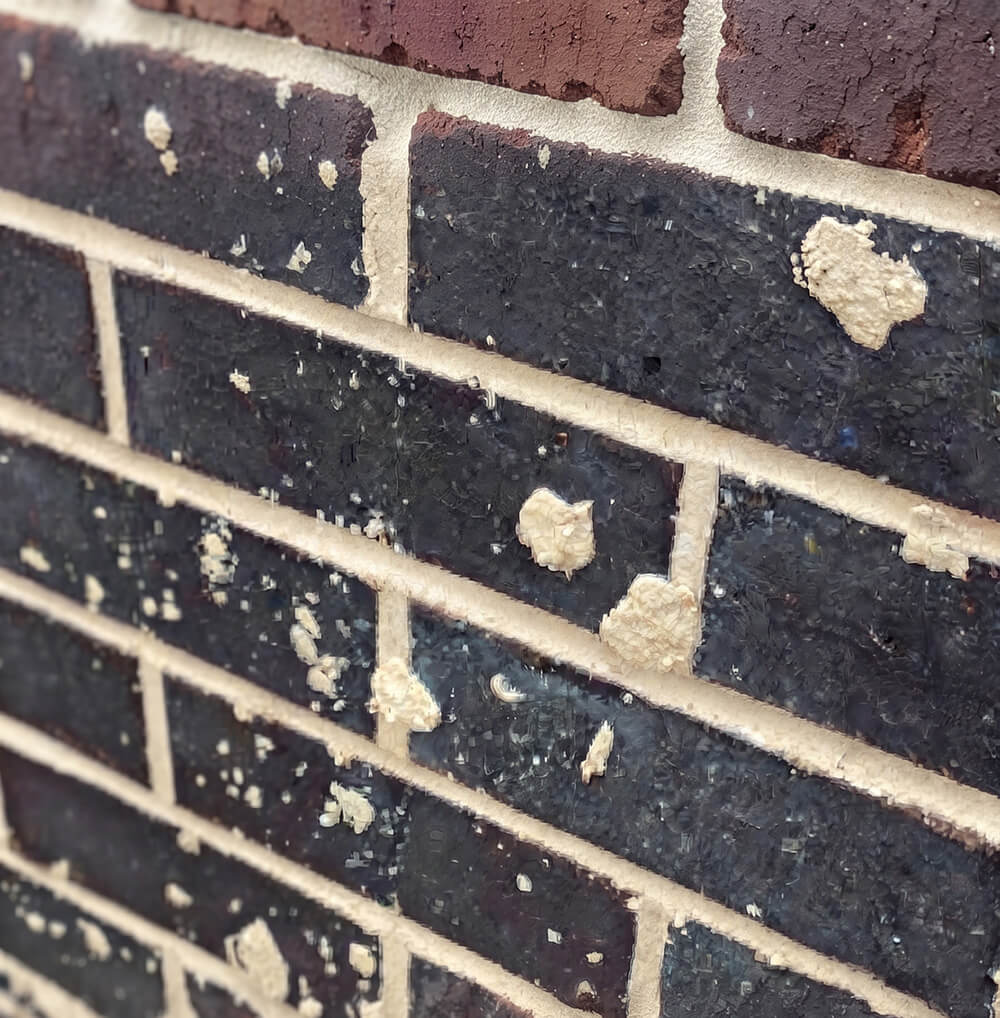
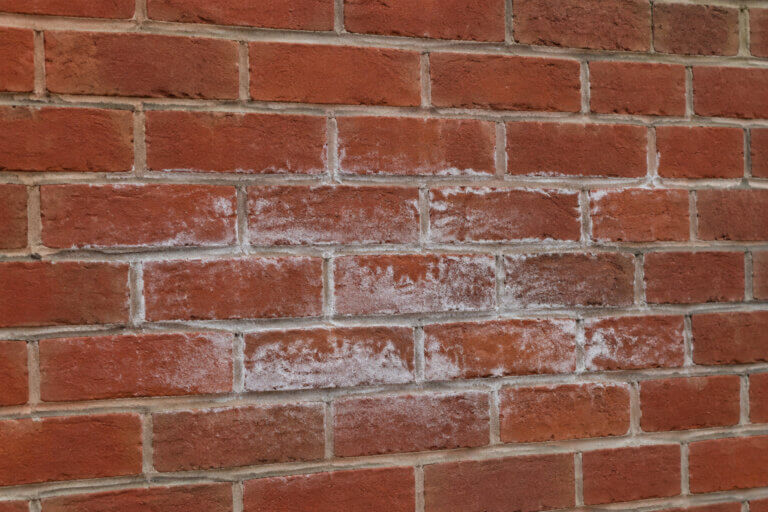
Efflorescence generally appears as a white, powdery deposit. It occurs when water moves through masonry, dissolves soluble salts and carries them to the surface. As the water evaporates, the salts remain.
Light efflorescence may disappear through natural weathering or be removable by gentle dry brushing. Persistent efflorescence can indicate an ongoing moisture source. Cleaning the visible salt without resolving the water entry may only provide a temporary improvement.
Possible moisture sources include:
The source of moisture should be investigated before repeated cleaning is undertaken.
Vanadium staining can appear yellow, green, brown or reddish-brown and is generally most visible on light-coloured clay bricks. Vanadium compounds occur naturally in some clays and can be mobilised by water and certain cleaning conditions.
It is not normally a structural concern, but an unsuitable acid treatment can intensify the stain, change its colour or make it more difficult to remove. Staining should therefore be identified before any hydrochloric-acid-based mortar cleaning is considered.
Elephant Brick Co advises that the risk can be reduced by keeping brickwork dry during construction and avoiding excessively wet mortar. Natural weathering may gradually reduce some vanadium staining. Specialist treatment may also be available, but it should be selected and carried out by someone who understands the chemistry involved.
Acid burn commonly appears as yellow, orange, pink, brown or rust-like discolouration. It can arise when hydrochloric acid reacts with iron-bearing compounds in bricks or mortar sand.
This is a prime example of cleaning causing the stain it was intended to remove. Applying more hydrochloric acid is unlikely to correct the problem and may make it worse.
Rust can also arise from external sources such as metal grinding particles, corroding fixtures, reinforcement, steel wool or runoff from metalwork. The source must be identified and corrected before stain removal is attempted.
Calcium staining may appear as a hard white or grey deposit and can be confused with efflorescence or mortar residue. It may arise from cement-rich water moving through or over the brickwork.
Because the appearance can resemble other deposits, correct identification is important. A treatment suitable for loose efflorescence may be ineffective against a hardened calcium deposit.
Manganese staining may appear brown, black or purple-brown. Like vanadium or iron staining, its removal requires correct diagnosis and a compatible specialist treatment. It should not automatically be treated as dirt or ordinary mortar residue.
Algae, moss, mould and lichen typically develop where brickwork remains damp, shaded or poorly ventilated.
Cleaning the growth without addressing the moisture conditions encourages its return. Leaking plumbing, irrigation, vegetation, drainage and persistent shade should all be considered. Biocidal products can affect people, plants, animals and surrounding materials and must be professionally selected and carefully controlled.
Airborne dust, traffic pollution, pollen, stormwater runoff and environmental contaminants accumulate gradually. These deposits are often more noticeable on white and pale-coloured bricks.
Gentle, periodic maintenance is preferable to allowing heavy contamination to develop and then resorting to an aggressive restoration clean.
These are specialist contaminants. Paint strippers, solvents and poultices may mobilise a stain and spread it deeper or over a wider area. Some products can also leave a permanent shadow or alter the appearance of the brick.
Overspray and spills should be prevented wherever possible. Once they occur, specialist advice should be obtained before applying solvents or paint-removal products.
White, cream, ivory, grey and other pale bricks naturally show dirt, mortar smears and environmental staining more readily than darker bricks. This does not mean the bricks are defective; it is an inherent characteristic of choosing a light-coloured surface.
Their clay composition can also make some light bricks more susceptible to visible vanadium or iron-related staining if inappropriate cleaning chemicals are used.
Cleaning methods, mortar selection and site protection should therefore be considered before laying begins—not after the wall has been completed.
Reclaimed and handmade bricks need to be understood on their own terms.
Residual mortar, weathered patina, colour variation, firing marks, chips, irregular edges and variations in texture may all be intentional characteristics. Aggressive cleaning can strip away the very features for which these bricks were chosen.
A new wall made from reclaimed brick is not generally intended to look like a wall of uniform, machine-made bricks. Before cleaning begins, the builder, cleaner, designer and client should agree on what is natural character and what is genuinely unwanted contamination.
Some visible problems are symptoms of water ingress, poor detailing or inappropriate construction rather than failures of cleaning.
Repeated cleaning will not resolve:
The underlying cause should be corrected first. Otherwise, staining and organic growth are likely to return.
A masonry cleaner that is compatible with brick may still damage glass, aluminium, painted surfaces, natural stone, concrete, timber, plants or paving.
Before any work begins, the cleaner must consider:
All chemicals should be used strictly in accordance with their current Safety Data Sheets and manufacturers’ instructions.
A breathable masonry sealer may help reduce absorption and make future maintenance easier in some environments, particularly where pale brickwork is exposed to vegetation, pollution or frequent handling.
However, sealing is not a cure for poor detailing, rising damp or ongoing water penetration. It will not prevent every stain, and an incompatible sealer may alter the brick’s colour, sheen, vapour permeability or weathering behaviour.
Any proposed sealer should be confirmed as suitable by both the brick supplier and sealer manufacturer and tested on a representative area before general application.
Professional cleaning should be strongly considered where:
For the best result, Elephant Brick Co recommends engaging a contractor accredited by Think Brick Australia. An experienced cleaner should assess the brick, mortar, stain, age of the work, surrounding materials and environmental conditions before recommending a process. Think Brick provides a current Brick Cleaning Guide and accredited-cleaner resources.
Successful brick cleaning is not about finding the strongest chemical or the most powerful machine. It is about identifying the problem correctly and using the least aggressive method capable of achieving an acceptable result.
Prevention during construction, careful diagnosis, consultation with the brick supplier, a properly assessed test panel and experienced professional cleaning are the best safeguards against permanent damage.
Brickwork can last for generations. Cleaning should preserve its character and durability—not become the process that damages it.
You are making a significant investment in your home, so why entrust your brickwork to someone who has not completed the Think Brick Australia Brick Cleaning Accreditation Course? Proper brick cleaning requires specialist knowledge, appropriate techniques and a clear understanding of how different bricks respond to cleaning products and processes. Choosing an accredited brick cleaner helps reduce the risk of staining, discolouration and permanent surface damage—protecting both the appearance of your brickwork and the value of your investment.
20 Aug 2026

06 Aug 2026
28 Nov 2024

19 Jun 2024

20 May 2024
04 Mar 2024
25 Aug 2023